No tuition dollars used for presidential residence, officials say
By: KOREY MCCASKILL
May 01, 2026
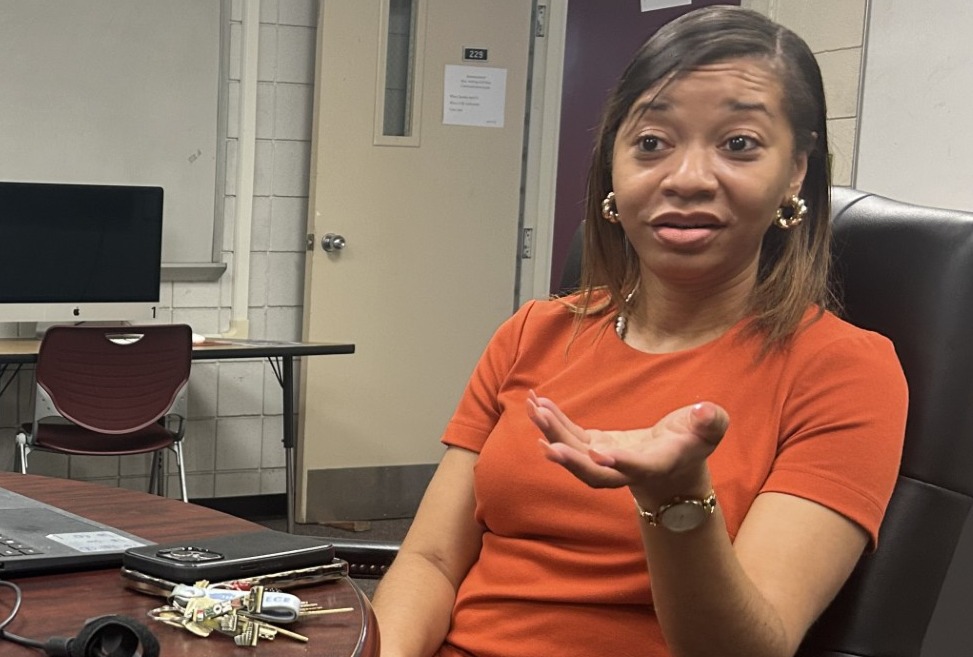
Ashley Schofield, interim vice president for fiscal affairs and chief financial officer at Claflin, speaks with Panther reporters.
Tuition dollars were not used to fund construction of a new Claflin University presidential residence, officials said.
“No student revenue was used to purchase or build this home,” said Ashley Schofield, interim vice president for fiscal affairs and chief financial officer at Claflin. The new residence off Riverbank Drive in Orangeburg was fully funded through fundraising efforts.
While providing no figures on cost, university leaders speaking with Panther reporters said the decision to relocate the president’s house, known as Dunwalton, is part of a larger campus master plan designed to support future growth and development.
“The move of the president’s house off campus was a board decision,” said Dr. Cletra Peters, vice president and chief of staff.
The previous residence, built in 1971, was leveled. It was named in honor of the university's third president, Dr. Lewis M. Dunton, who served from 1884 to 1922.
The original location of the on-campus residence is now being repurposed to make way for a new biotechnology building near the student center. The placement is intended to highlight the university’s academic expansion and create a stronger visual presence along Magnolia Street.
“The number one spot recommended for the new biotech building was next to the student center for the front vision, so when people are on Magnolia, they get to see these brand-new buildings,” Peters said.
Officials said the new residence has a long-term purpose beyond the current administration.
“What happens is Dr. Warmack is not going to be president forever, and so what this does is provide a space that’s appealing when you’re recruiting future presidents,” Peters said.
Officials also discussed the university’s broader financial approach.
“Most private institutions do at least 5% increase to keep up with inflation and operational costs across the country,” Schofield said.
Since 2018, there has only been one tuition increase. A 5% increase was implemented for the 2025-26 academic year to help offset rising operational costs after seven years without change.
Schofield said that increase has not been enough. But instead of increasing tuition further, President Dwaun Warmack sees fundraising as the primary way to support the university financially, not placing additional financial burden on students.
“He fundamentally believes that it’s his job to go out and fundraise for the gap between operational costs,” Schofield said. “He is out meeting with donors on a consistent basis to cover those additional costs for us to operate going forward.”
Housing has also remained a major concern among students.
Previous discussions about a potential partnership with South Carolina State University to house students at Railroad Corner did not move forward due to high costs, Peters said.
“At the time, we were engaged in conversations, but Dr. Warmack shied away when the cost was too high,” Peters said.
University officials say additional housing options are still being explored, particularly as enrollment changes.
Concerns about mold in residence halls have also circulated, but Schofield and Peters say testing had found no evidence of mold.
“It’s mildew, not mold,” Schofield said. “We live in South Carolina, and humidity is a major factor. While residue may appear on walls, we have companies that test immediately to ensure there are no health or safety concerns.”
Beyond immediate concerns, officials say long-term maintenance and modernization of residence halls are ongoing challenges.
“We have what you call capital project funding each year, and what you’re seeing right now is a perfect storm,” Schofield said. “All of our residential facilities are over 20 years old, which means a lot of mechanical systems, like elevators, are aging.”
The university has already made significant investments in infrastructure, including a new HVAC system in Dunton Hall installed prior to Warmack’s presidency.
“These modernization projects can cost hundreds of thousands, sometimes millions of dollars,” Schofield said.
Because of the scale of these repairs, most work is scheduled during the summer months.
“What we do is plan repairs during the summer, and some of these projects take three to six months, sometimes even up to a year, to complete,” Schofield said.
Officials also noted that supply chain challenges can delay progress.
“When we talk about sourcing parts, a lot of this comes from overseas, China,” Schofield said.
“It’s not like we can go across the street and get what we need,” Peters said. “We’re often at the mercy of those companies.”
Despite these challenges, facilities teams are working with students and actively pursuing modernization plans to improve living conditions across campus, the officials said.