Williams: 21 patrolmen refused to shoot in 1968
By: KOREY MCCASKILL
Feb 20, 2026
“Twenty-one white highway patrolmen refused to shoot the students and in my opinion that has to be brought out because that tells the good in humanity,” Cecil Williams said.
During 58th annual commemoration of the Orangeburg Massacre, Williams, a 1960 graduate of Claflin University, recalled his experience and details often untold.
The events began Feb. 7, 1968, when students protested segregation at All-Star Bowling alley. During the demonstration, a window at the bowling alley was broken. As officers began drawing their weapons, students ran toward the college campus for safety.
Tension escalated after Emma McCain, South Carolina State University student, fell on the sidewalk and was beaten by Orangeburg police, sustaining injuries.
“They started to throw rocks at cars and doing violent things as they went towards the campus because that was the only way they could think of in their minds to retaliate,” Williams said of the fleeing students.
“Because students broke windows and threw rocks at cars, they were contained on the campus of South Carolina State on Feb. 8,” Williams said.
Law enforcement soon surrounded the campus.
“In the street along Magnolia, there were national guardsmen, highway patrolmen, city police and the Orangeburg fire department.”
“On the scene there was 30 highway patrolmen and all of them were asked to load their weapons, to go and engage the students and shoot them on the campus,” Williams said.
“But only nine obeyed the highest-ranking law enforcement officer on the scene, and that was chief of SLED, Pete Strom,” Williams said. “So in a way, 21 white highway patrolmen refused to shoot the students, and in my opinion that must be brought out because that tells the good in humanity.”
Williams continued, “Guess what, I always believe there were more good people then bad people. This is the rest of the story; this was the backstory,” he said.
He added that 21 officers could have faced consequences for disobeying the order.
“The other 21 could’ve been fired, they could have been charged with disobeying their officer, but it goes to the goodness in mankind.”
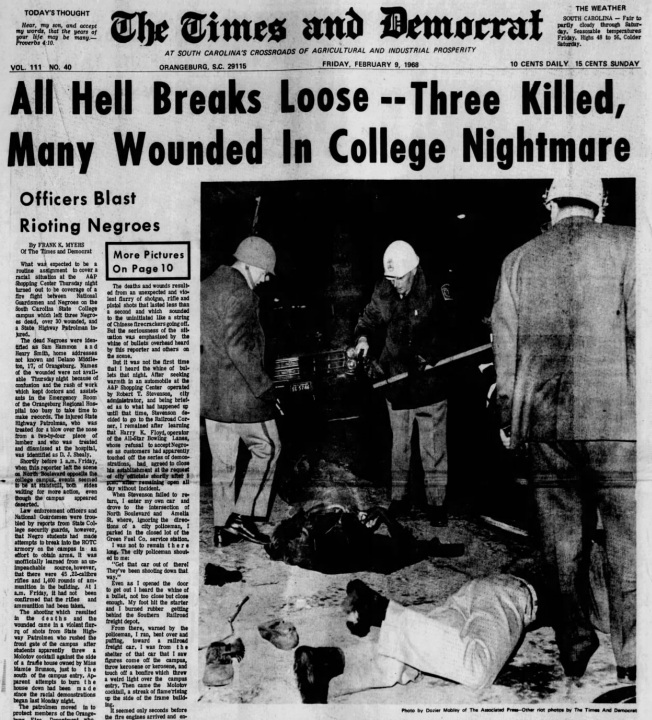
The Orangeburg Massacre left three students dead and 28 injured.
On Feb. 9, 1968, Williams and then-SC State dean of students Oscar Butler walked to what Williams described as the “murder site.” With no crime scene tape blocking the area, they collected shotgun shells and debris. Williams said he gathered 12 shells.
Today, Williams continues to tell the story of the Orangeburg Massacre and the civil rights movement through his photography. His work is displayed, along with the shotgun shells at the Cecil Williams South Carolina Civil Rights Museum, which is expected to relocate to a new building across the street from S.C. State at the intersection known as Railroads Corner.